
- The net balance of small businesses reporting revenue growth over the previous three months stood at -7.1% in Q1. This marked the fourth consecutive negative reading on this measure, reflecting the pressures on revenue from high input prices and weaker consumer demand.
- The net balance of exporting businesses reporting growth in the value of their exports stood at -17.7% in Q1. This marked the sixteenth consecutive quarter for which the net balance of exports has stood below zero. This indicates exporters are still facing unfavourable conditions.
- 91.8% of businesses reported increased costs compared to a year ago in Q1. This represents the highest net balance figure on this measure since data collection began, highlighting the widespread nature of cost pressures at present.
Reproduced from FSB
Every conversation FSB has had with our members over the past few months has touched on two issues – spiralling costs, and a stark shortage of labour. Cost increases are now affecting everything from the price of petrol to cooking oil to timber to orange juice to laundry detergent, and much more besides. Inflation is the overriding economic concern among FSB’s membership, with the series-high reading of 89.0% of firms reporting higher costs than a year ago a stark illustration of the toll it is taking. The cost of doing business crisis, which we raise frequently with politicians and the media, is in turn adding to the cost of living crisis affecting households, as businesses have no other choice than to pass on higher costs, creating a vicious circle. The cost of doing business crisis has exacerbated a crunch on small businesses being able to recruit talent, which may mean this autumn businesses having to close their operations on days without staff cover, and to save on exponential energy bills.
The suppression of small businesses’ ability to grow and invest, by making it impossible for all too many of them to think about anything beyond survival, is a sign that the UK’s long-running ‘productivity puzzle’ looks set to stay in place for some time yet. Some say certainty is what small businesses crave; however, a certainty of rocketing costs and prices into the medium term will do the opposite, making many small businesses simply unviable. It’s hardly surprising that they are battening down the hatches, focusing on the essentials, and looking to cut costs wherever they can, rather than seeking funding to invest in new technology, premises, or processes.
Growth is firmly off the menu for the majority of small businesses, with 38.7% planning to stay the same size, and 14.7% – one in seven – expecting to downsize or even close their business over the next 12 months. The success of small firms’ credit applications remained well below the pre-pandemic trend, at 44.9%, while the number of firms reporting they had even applied for finance in the first place was 11.5%, up from the record low of 9.1% in Q1 2022. The credit on offer has also ticked up in price, a predictable consequence of the rise in the Bank of England base rate seen over the quarter, but an additional pressure on budgets nonetheless, and one likely to get worse in the coming quarter, given the 50 basis point rise decided in August.
Likewise, the first fall in employee numbers since Q1 2021 was recorded, falling far short of relatively buoyant hiring intentions in last quarter’s survey, and showing the speed with which inflation pressures have overtaken many firms’ plans. Access to skilled staff also ticked upward as a cited barrier to growth, up to 33.9% in Q2 from 31.3% in Q1, with the domestic economy however far and away the most-cited barrier to growth, at 65.1%, up from 58.6% in the previous quarter.
It is beyond clear that the Government needs to act, to help businesses facing acute pressures. The next Prime Minister must affirm their commitment to small businesses, self-employed people, and entrepreneurialism, and take swift action on urgent sources of pain which threaten the survival of countless firms. The economic devastation that inaction would cause must spur decisive intervention before it is too late for countless small businesses.]
Key Statistics:
Costs reach a new high – 89% of small businesses report higher costs compared to a year ago.

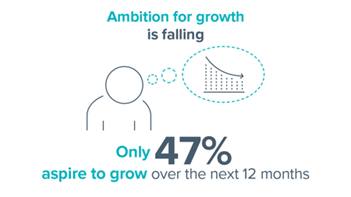
Ambition for growth is falling. Only 47% aspire to grow over the next 12 months.
Small businesses are struggling to access finance. Just 45% of financial applications were successful in Q2

A net balance of 31.9% of small businesses expect to grow over the coming year. This is a considerable deterioration from Q1, when the net balance stood at 39.1%, highlighting the dampened economic outlook that has emerged in recent months. The domestic economy remains the most commonly cited barrier to growth amongst respondents.
